ObjectivesLearning outcomesIIIIIIIVVVIVIIVIIIElective Courses
Degree Program
Undergraduate study program, 4 years, 8 semesters, 240 ECTS credits
Level of qualification
Bachelor of Science in Electrical Engineering and Information Technologies, specialized in Telecommunications and Information Engineering
Profile
Telecommunications and Information Engineering
Occupational Profiles of Graduates
Graduate engineers from the study program Telecommunications and Information Engineering are prepared for modern and dynamic job positions in the ICT sector, both in the country and abroad. Their knowledge and skills in telecommunications technologies, network systems, telecom and Internet services, software tools and communication and information platforms enable successful inclusion in:
- telecom, mobile and Internet operators
- companies for the design, development and maintenance of telecommunications and network infrastructure
- software and IT companies that develop digital and cloud services
- industry for the production and integration of telecommunications equipment
- companies related to cybersecurity, data processing and IoT solutions
- any small, medium and large company or institution with its own network and that uses or provides digital services to citizens and businesses
- research centers, technology parks and academic institutions around the world
The demand for engineers in this field is continuously high, following global trends in the development and application of current 5G and future 6G mobile networks, optical networks, Internet and web technologies, cloud platforms, cybersecurity, software-defined networks, automation, development and application of artificial intelligence in telecom/ICT, as well as for the digital transformation of all businesses, institutions and industries.
The Programme Learning Outcomes
The study program equips students with modern knowledge and practical skills across the entire spectrum of communication and information technologies. It provides knowledge in telecommunication systems, network technologies, programming, cloud solutions and cybersecurity, as well as competencies for analysis, design, implementation and optimization of complex communication and ICT / IT systems, networks and services.
More specifically, students on this study programme acquire competencies and abilities for:
- Analysis, design and implementation of telecommunications systems and protocols, including digital communications, wireless systems, mobile networks and optical communications.
- Understanding and application of modern network and system architectures, such as Internet technologies, 5G and future 6G mobile networks, satellite communication, IoT (Internet of Things) systems, software-defined networking, virtualization and container-based platforms.
- Design, configuration and administration of wired, wireless and mobile networks, for Internet service, telephony, television, IoT services, as well as services for extended reality (XR).
- Programming and development of software applications and operating systems for telecommunications, web services, mobile applications and server-side web environments.
- Design and modeling of databases and information systems, application of Internet technologies and development of network-oriented services.
- Use of cloud and edge computing systems, as well as distributed platforms for data processing, storage and analytics.
- Analysis, simulation and optimization of communication systems using specialized simulation tools and software methods.
- Application of the principles of cybersecurity, network and data protection, secure communications, network forensics and risk management.
- Development and implementation of Internet of Things (IoT) systems, personal ad-hoc networks and smart devices.
- Application of machine learning and artificial intelligence in telecommunications for optimization, prediction and support, as well as design of intelligent telecommunications and information systems.
- Understanding of regulations, standards and industry trends in the telecom / ICT / digital sector and their application in the development, planning and integration of systems, networks and services.
International Accreditation
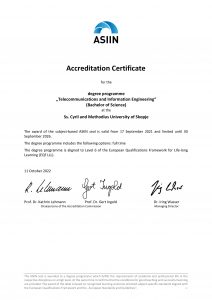
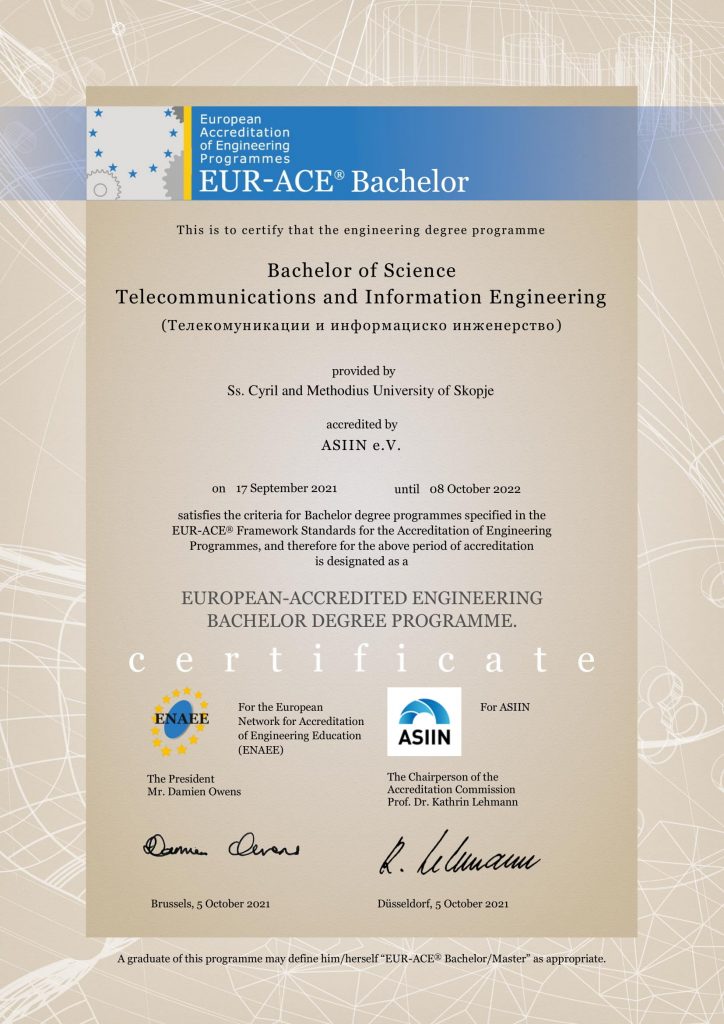
The undergraduate study programs at FEEIT are accredited by the German Accreditation Agency for Study Programmes in Engineering, Informatics, Natural Sciences and Mathematics (ASIIN), which is a world leader in quality assurance in higher education. This accreditation confirms that the study programs satisfies the criteria for Bachelor degree programs specified in EUR-ACE Framework standards for the accreditation of engineering programs and the content studied are relevant to areas covered in study programs.
General Learning Outcomes
| Knowledge and understanding |
- Demonstrate knowledge and understanding in the scientific field of electrical engineering, based on education and training, including knowledge of theoretical, practical, conceptual, comparative, and critical perspectives in the scientific field according to the appropriate methodology.
|
| Application of knowledge and understanding |
- Demonstrate the ability to apply acquired knowledge and understanding in a professional manner.
- An ability to identify, analyze and solve complex engineering problems by selecting an appropriate method.
|
| Ability to assess |
- An ability to collect, analyze, evaluate and present information, ideas, and concepts based on relevant data.
- Making an appropriate assessment taking into account personal, social, scientific and ethical aspects.
|
| Communication skills |
- An ability to communicate effectively in both verbal and written forms with professional and non-professional audiences.
- An ability to work effectively as an individual or as a member of a team taking shared responsibility for collective results.
- Ability to participate independently, in a professional manner, in regards to scientific and interdisciplinary discussions.
|
| Learning skills |
- Commitment to the professional development and lifelong learning achieved through higher education, technical training, membership in professional societies, and other activities in order to update already acquired knowledge in the relevant field to achieve continuous professional growth.
- An ability to acquire and apply new knowledge as needed using appropriate learning strategies.
|
Specific Learning Outcomes
| Knowledge and understanding |
- Demonstrate knowledge and understanding in the scientific field of electrical engineering, based on education and training, including knowledge of theoretical, practical, conceptual, comparative, and critical perspectives in the scientific field according to the appropriate methodology.
- Demonstrates knowledge and understanding of research, development and application of knowledge in telecommunication and information engineering, as well as engineering design in industrial processes.
- Understanding and knowledge of current issues related to scientific research and new sources of knowledge.
|
| Application of knowledge and understanding |
- An ability to identify, analyze and solve complex engineering problems.
- An ability to apply knowledge and understanding in a way that demonstrates professionalism to the relevant field or profession.
- An ability to identify, analyze and solve problems related to telecommunication and information engineering.
|
| Ability to assess |
- An ability to collect, to analyze, evaluate and present information, ideas and concepts from relevant data.
- Making an appropriate assessment taking into account personal, social, scientific and ethical aspects.
- An ability to provide answers to both theoretical and practical issues, in order to give explanations and choose the appropriate solution.
- An ability to collect, to analyze, evaluate and present information, ideas and concepts from relevant data in the field of telecommunication and information engineering.
|
| Communication skills |
- An ability to communicate effectively in both verbal and written forms with professional and non-professional audiences.
- An ability to work effectively as an individual or as a member of a team taking shared responsibility for collective results.
- An ability to participate independently and professionally in specific, scientific and interdisciplinary discussions.
|
| Learning skills |
- Commitment to professional development and lifelong learning through higher education, technical training, membership in professional societies, and other activities in order to update already acquired knowledge in the field and to achieve continuous professional growth.
- An ability to acquire and apply new knowledge as needed, using appropriate learning strategies.
- Demonstrate a high degree of independence initiative for learning and professional development.
- Understanding the need for learning and ability for continuous professional development, through the use of professional and scientific literature, professional training, continuing formal education, membership in professional organizations, etc.
- Awareness of new technologies and the ability to evaluate and use modern software development tools.
- An ability to use information technologies for distance and e-learning.
- Skills for cooperative, competitive and individual learning.
- Applying active teaching and learning techniques.
|
| During studying, the student may choose up to 4 courses from the faculty list of electives |
| During studying, the student may choose up to 4 courses from the faculty list of electives |
| During studying, the student may choose up to 4 courses from the faculty list of electives |
| During studying, the student may choose up to 4 courses from the faculty list of electives |
| During studying, the student may choose up to 4 courses from the faculty list of electives |
| During studying, the student may choose up to 4 courses from the faculty list of electives |